
AI voice and operations platform, customer call automation, service request workflow, call to task tracking, connected operations platform

From Call to Resolution: How VoiceTact and OpsStak Work Together

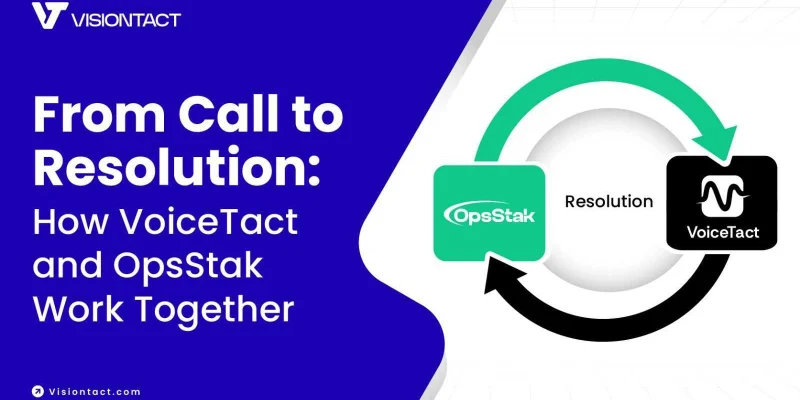
VoiceTact and OpsStak are two VisionTact platforms that work together to connect customer communication with operational execution. VoiceTact handles the inbound call with an AI voice agent and captures what the customer needs. OpsStak turns that request into a structured, tracked task with a clear owner and deadline. Together they form a call to workflow automation system that follows a request from the moment it is spoken to the moment it is resolved.

The Gap Between the Call and the Work

A customer calls with a problem. Maybe it is a maintenance request, a service issue, a complaint, or a question that needs someone to do something afterward. The call gets answered, the customer explains what they need, the agent says it will be taken care of, and the call ends. So far so good. Then comes the part that quietly breaks in most organisations: turning that conversation into action that actually happens.

In a lot of operations, what happens next is informal. The agent writes a note, sends a message to whoever they think handles that kind of thing, or logs it in a system that the operations team does not always check. The request now lives in a gap between the team that took the call and the team that has to do the work. Sometimes it gets picked up quickly. Sometimes it sits. Sometimes it gets lost entirely, and the first anyone hears about it again is when the customer calls back, annoyed, to ask why nothing happened.

This is the gap between the call and the work. The customer experienced a clear moment of being heard. The organisation experienced a handoff with no structure behind it. And the distance between those two things is where customer trust gets damaged, because a promise made on a call that does not turn into action is worse than no promise at all.

The problem is not the call handling, and it is not the operations team. It is that the two are connected by nothing more reliable than a note and a hope. VisionTact built VoiceTact and OpsStak to close that gap, by connecting the conversation where a request is made to the structured workflow that gets it resolved.

What VoiceTact and OpsStak Each Do

Before looking at how they connect, it helps to be clear on what each platform does on its own. Both are fully standalone products.

VoiceTact: the conversation side

VoiceTact is VisionTact’s AI voice agent platform. It answers inbound and outbound calls with conversational AI that speaks naturally, handles routine interactions end to end, qualifies leads, and routes or escalates calls with full context. It supports Arabic and English natively and operates around the clock without additional staffing. In short, it handles the front end of customer communication consistently and at volume. You can read the full detail in What is VoiceTact? AI Voice Agent Platform Explained.


OpsStak: the execution side

OpsStak is VisionTact’s AI operations platform. It turns standard operating procedures into structured digital workflows, assigns clear ownership and deadlines to every task, and gives managers a real time dashboard view of what is completed, in progress, or delayed. It is the platform that makes sure work actually gets done, consistently and visibly. You can read the full detail in What is OpsStak? AI Operations Platform Explained.


How the Two Platforms Work Together

The connection between VoiceTact and OpsStak is built around a single idea. A customer request should not depend on a handwritten note to survive the journey from the phone call to the people who can act on it.
 
When a VoiceTact interaction produces a request that needs operational follow up, that request can become the trigger for a structured workflow in OpsStak. The call comes in, the AI voice agent captures what the customer needs, and instead of that information sitting in a note or a message, it can flow into OpsStak as a tracked task with an owner and a deadline.
 
From that point, the request lives inside a structured operation rather than in a gap. The operations team sees it on the real time dashboard. It has clear accountability, so someone specific is responsible for resolving it. Its status updates as work progresses. And when it is done, the resolution is recorded. The customer call that reported the problem and the operational task that fixed it become part of the same connected record rather than two disconnected events in two separate systems.
 
This changes what a promise on a call actually means. When an agent, or an AI voice agent, tells a customer their request will be handled, that statement is now backed by a structured workflow rather than a hope that someone picks up the note. As a call to workflow automation system, VoiceTact and OpsStak are designed to make the journey from spoken request to completed work one continuous, visible flow.
 
As always with VisionTact platforms, the boundaries are clear. Both products remain fully usable on their own. An organisation can run VoiceTact for call handling without OpsStak, or OpsStak for operations without VoiceTact. The connection is an advantage for teams that choose both, not a requirement.

Who This Is For

The connected VoiceTact and OpsStak workflow is most valuable for organisations where customer calls regularly generate work that someone has to do, and where the handoff between the two is currently informal.

  • Operations leaders who are accountable for getting things done but rely on customer facing teams to pass requests along reliably, and want that handoff to be structured rather than improvised.
  • Customer experience leaders who know that a request made on a call is only as good as the follow through, and want every promise made to a customer backed by a tracked task.
  • Facilities management teams where calls reporting maintenance issues, faults, or service needs have to turn into scheduled, tracked work across multiple sites.
  • Healthcare providers and clinics where patient calls often require operational follow up, and where a dropped request can have real consequences.
  • Service businesses of all kinds where the phone is a primary channel for customer requests and the operation behind it has to deliver consistently.
  • Founders and growing companies that want to connect their customer communication and their operations on structured infrastructure rather than letting an informal handoff become a recurring source of dropped requests.

These are organisations in sectors like facilities management, healthcare, commercial services, real estate, and government, where calls and operational follow through are both run at meaningful scale.

How It Works

Bringing VoiceTact and OpsStak together follows a clear path that mirrors the natural journey of a customer request.

  • Step one: handle the call in VoiceTact. A customer calls and the AI voice agent answers, understands the request, handles what it can directly, and identifies when the request needs operational follow up. By the end of the call, VoiceTact has captured a clear, structured description of what the customer needs.
  • Step two: turn the request into a tracked task. When a request needs follow up, it can flow into OpsStak as a structured task rather than a note. This is the step that closes the gap, because the request now enters a system built to make sure work gets done.
  • Step three: execute with accountability in OpsStak. The task is assigned to the right owner with a deadline, appears on the operations dashboard, and moves through the workflow with its status visible the whole way. Nobody has to wonder whether the request was picked up, because the platform shows it.
  • Step four: resolve and record. When the work is complete, the resolution is recorded against the task. The original call and the work that resolved it are connected in one record, which means the operation can see, end to end, how customer requests are being handled.

Why It Matters

The value of connecting calls to operations is easy to underestimate, because the cost of leaving them disconnected is spread out and quiet. A single dropped request does not look like a systemic problem. It looks like a one off. But across an operation handling many calls a day, the steady leak of requests that fall through the gap adds up to a real and recurring source of customer frustration and operational rework.

When a customer request becomes a tracked task automatically, fewer requests get lost. The reliance on someone remembering to pass along a note disappears, and with it the most common reason that promises made on calls do not turn into action.

When every request has a clear owner and a deadline, follow through becomes the default rather than something that depends on individual diligence. The structure does the work that used to depend on people not forgetting.

When the operations team can see incoming requests on a real time dashboard, they can manage workload and prioritise properly rather than reacting to whatever surfaces loudest. Visibility turns a stream of incoming requests into something manageable.

When the call and the resolution are connected in one record, leadership can finally see how well the organisation closes the loop on what customers ask for. That visibility, the ability to measure how reliably a spoken request becomes completed work, is something most operations simply do not have today, because the call lives in one place and the work lives in another.

None of this requires overstating the case. The point of connecting VoiceTact and OpsStak is simple: a customer request should not depend on a note and a hope to survive the trip from the phone to the people who can act on it.

How This Fits Into the VisionTact Ecosystem

VoiceTact and OpsStak are two of the five platforms VisionTact has built, each addressing a different part of how a modern enterprise operates. The call to resolution connection described in this post is one example of a broader principle behind how VisionTact builds: each platform is complete on its own, and each is designed to connect naturally with the others when an organisation is ready.

The same thinking shows up elsewhere in the ecosystem. On the people side, VisionTact’s hiring and HR platforms connect so that the context built during recruitment carries into employee management, which you can read about in the post on how TalentSage and PeopleSage work together. The pattern is consistent: standalone where you need it, joined up where it adds value.

To understand the full picture and the thinking behind building a connected ecosystem rather than a single monolithic tool, the foundational article on this blog is Houston to Dubai: How VisionTact Builds AI for Global Enterprises.
 
The connection between calls and operations is one of the clearest places to see that philosophy in action, because the journey from a customer request to a resolved task is one most organisations experience as broken, and it does not have to be.

Conclusion

The gap between the call and the work is one of those problems that hides in plain sight. The call gets handled well, the operation works hard, and yet requests still slip through the space between them, because that space is held together by nothing more reliable than a note and good intentions. Customers feel it as promises that did not turn into action, and operations leaders feel it as rework and recurring complaints they cannot quite trace to a single cause.

VoiceTact and OpsStak are designed to close that gap. As a call to workflow automation system, they connect the conversation where a request is made to the structured workflow that gets it resolved, so a spoken request becomes a tracked task and follows through to completion in one visible flow. Each platform stands on its own, and together they make customer communication and operational execution work as a connected whole.

If your organisation handles customer requests by phone and relies on an informal handoff to turn those requests into action, the most useful next step is to see how the two platforms connect and discuss how that maps to your operation.

Explore VoiceTact at voicetact.com  and OpsStak at opsstak.com, or talk to VisionTact about connecting them.

Frequently Asked Questions

How do VoiceTact and OpsStak work together?

VoiceTact handles the inbound call with an AI voice agent and captures what the customer needs. When a request needs operational follow up, it can flow into OpsStak as a structured task with a clear owner and deadline. This connects customer communication to operational execution, so a spoken request becomes tracked work through to resolution.

Do I have to use both VoiceTact and OpsStak together?

No. Both are fully standalone platforms. You can use VoiceTact for call handling without OpsStak, or OpsStak for operations without VoiceTact. The connection between them is an advantage for organisations that choose both, not a requirement.

What is call to workflow automation?

It is a setup where a customer request made on a call flows directly into a structured operational workflow rather than depending on a handwritten note or an informal handoff. The request becomes a tracked task with an owner and a deadline, so it reliably turns into action.

What kind of requests can flow from VoiceTact into OpsStak?

Any customer request that needs operational follow up, such as maintenance issues, service requests, faults, or tasks that someone has to complete after the call, can be turned into a tracked task in OpsStak rather than living in a note or a message.

Why does connecting calls to operations matter?

When customer requests become tracked tasks automatically, fewer get lost, every request has a clear owner and deadline, the operations team gets real time visibility, and leadership can see how reliably the organisation turns spoken requests into completed work. Leaving the two disconnected quietly loses all of that.

Who benefits most from connecting VoiceTact and OpsStak?

Operations leaders, customer experience leaders, facilities management teams, healthcare providers, service businesses, and growing companies that handle customer requests by phone and need those requests to reliably become tracked, completed work.

Are VoiceTact and OpsStak built by the same company?

Yes. Both are built by VisionTact, an AI development company with offices in Houston, Texas and Dubai Silicon Oasis, UAE. Because they share a maker, they are designed to connect rather than being two unrelated tools forced together.

Where can I learn more about each platform?

VoiceTact is available at voicetact.com and OpsStak is available at opsstak.com. VisionTact, the company behind both, can be reached at visiontact.com to discuss connecting them.
Share Blog
You may like
Vision Tact White Logo

Join our community: Sign up for the newsletter and enjoy a curated dose of cool reads every week.

Follow Us

Let's Talk About Your Business Goals

Book your free 30-minute strategy session. No commitment, no hard sell  just real advice tailored to your needs.

Waiting List Form
Please enable JavaScript in your browser to complete this form.
Name