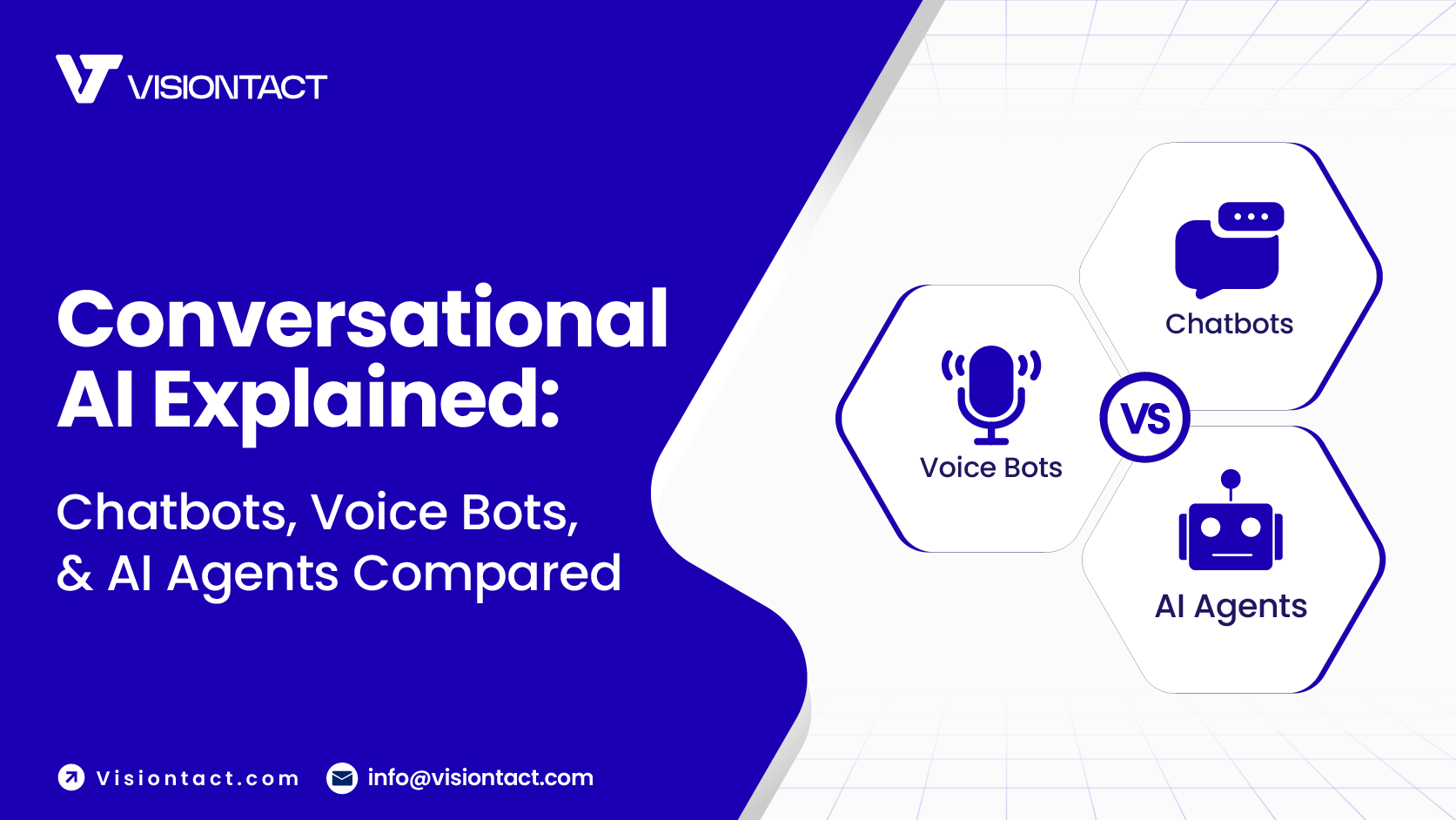
Conversational AI Explained: Chatbots, Voice Bots, and AI Agents Compared
Conversational AI is the family of technologies that lets software hold natural conversations with people, by text or voice. Within that family, the types differ by how much they can do. Chatbots converse within limits and answer questions. Voice bots do the same over the phone. AI agents go further: they can act on what was discussed, resolving requests end to end rather than just talking about them. Choosing between them comes down to one question: do you need the system to answer, or to act?
The Terminology Problem Costing Buyers Money
Sit through three vendor pitches for conversational technology and you will hear the same words meaning different things. One vendor’s chatbot is a page of scripted buttons. Another’s chatbot understands free text and searches a knowledge base. A third calls essentially the same product an AI agent because the term sells better this year. Voice bot, virtual assistant, digital human, conversational agent: the labels multiply faster than the meanings, and the confusion is not accidental. Vague terminology lets weak products borrow the reputation of strong ones.
For a buyer, this is expensive. Organisations regularly purchase a scripted bot expecting it to resolve customer requests, discover it can only deflect them, and conclude that conversational AI does not work. The technology did not fail. The label did. The product they bought was never capable of what the pitch implied, and the gap was hidden inside an undefined word.
The fix is not technical knowledge. It is a clear mental model of the three genuinely different things being sold under one umbrella, and one sharp question that separates them. This guide provides both, in plain terms, so the next pitch you sit through gets evaluated on what the system actually does rather than what it is called.
What Is Conversational AI
Conversational AI is the family of technologies that lets software hold a natural conversation with a person, in text or in voice.
Under the surface, systems in this family share common machinery: they interpret what a person says, including the informal, incomplete way people actually communicate, work out the intent behind the words, and respond in natural language. The better systems maintain context across a conversation, so a follow up question is understood in light of what came before rather than treated as a fresh start.
What the family shares is the conversation. What divides it is everything after the conversation: whether the system can only respond, or whether it can act. That single distinction, answering versus acting, is the spine of this entire guide, and it is the distinction the marketing labels most often blur. The three sections that follow walk the spectrum from least capable to most.
The Three Types Compared
Chatbots: Conversation Within Limits
The chatbot is the most familiar member of the family: the chat window on a website, the messaging assistant, the FAQ helper.
A chatbot’s job is to answer. It fields common questions, retrieves information from a knowledge base, guides a visitor to the right page or form, and collects details before handing a conversation to a person. Modern chatbots built on current language technology do this far better than the rigid, button driven bots of a few years ago: they understand free text, tolerate typos and slang, and respond naturally.
What defines the chatbot is not weak conversation but limited consequence. When a customer asks a chatbot where their order is, a good one explains the tracking process. It does not look up the actual order, because it is not connected to the systems where the order lives. It talks about the work. It does not do the work.
That makes chatbots the right tool where the job genuinely is answering: high volumes of repeated questions, first line support deflection, lead capture, simple guidance. Deployed for that, they deliver. Deployed with the expectation that they will resolve requests, they disappoint, and that mismatch, not the technology, produces most chatbot regret.
Voice Bots: The Conversation Moves to the Phone
A voice bot is conversational AI applied to speech: it listens, understands, and talks back, most commonly on business phone lines.
Voice raises the technical bar considerably. The system must recognise speech accurately across accents, background noise, and phone line quality, respond fast enough that the exchange feels like conversation rather than dictation, and speak naturally enough that callers stay engaged. In multilingual markets the bar rises again: a voice system serving the Gulf, for example, needs to handle Arabic and English, and callers who move between them, without forcing anyone through a language menu.
It is worth separating voice bots from their ancestor, the IVR phone menu. Press one for billing, press two for support is not conversational AI. It is a fixed script navigated by keypad, and callers’ dislike of it is precisely the market gap voice bots exist to fill. A real voice bot lets the caller simply say what they need, in their own words, and takes it from there.
Like chatbots, though, a voice bot as such answers rather than acts. It can tell a caller the clinic’s opening hours. Whether it can actually book the appointment depends on whether it is connected to systems and empowered to act, and the moment it is, it has crossed into the third category.
Conversational AI Agents: From Answering to Acting
The agent is where conversational AI stops being an interface and becomes a worker.
A conversational AI agent holds the same natural conversation, by text or voice, and then acts on it: it looks up the account, checks the history, applies the policy, books the appointment, processes the change, creates the follow up task, and escalates to a human only when the case genuinely needs one, handing over a full summary rather than making the customer repeat themselves. The conversation is no longer the product. The resolved outcome is.
A production example makes it concrete. VoiceTact, VisionTact’s AI voice agent platform, operates in this third category on live business phone lines. It converses naturally in Arabic and English, resolves routine matters end to end, qualifies sales enquiries through structured questions, routes complex cases to the right human with context attached, and runs around the clock. A caller experiences a conversation. The business receives an outcome: a resolved query, a qualified lead, a booked appointment. The full detail is in
What is VoiceTact? AI Voice Agent Platform Explained.
The Comparison at a Glance
The differences compress into four questions worth asking about any conversational system you are offered.
- What can it understand? Scripted bots understand button presses. Modern chatbots and voice bots understand natural language. Agents understand natural language plus the situation: who this customer is, what their history shows, what this specific case needs.
- What can it do? Chatbots and voice bots answer, retrieve, and route. Agents act: they change things in real systems and carry requests through to resolution.
- What happens with a hard case? A chatbot hands the customer to a queue. An agent escalates with the case already worked: identity confirmed, details gathered, history summarised, so the human starts at the middle rather than the beginning.
- What does it cost to be wrong? Buying a chatbot when you needed an agent means paying twice, once for the tool and again in the customer frustration it deflects rather than resolves. Buying an agent’s capability for a job that only needed answers is simply overspending. The match matters in both directions.
And the single sharpest question for any vendor: after the conversation, what has actually changed in our systems? If the honest answer is nothing, you are looking at a chatbot, whatever the pitch calls it.
Who This Is For
- Business leaders and buyers currently comparing conversational AI vendors, who need the vocabulary to see through label inflation and match products to problems.
- Customer experience leaders deciding how much of their support volume can be served by conversation technology, and which tier of it: deflection, guidance, or genuine resolution.
- Operations leaders whose phone lines carry real operational load, service requests, bookings, enquiries, and who need to know whether a voice system can carry outcomes or only greetings.
- Leaders in multilingual markets, particularly the Gulf, where a conversational system that cannot handle Arabic and English naturally is solving only part of the problem.
- Teams with a disappointing chatbot already deployed, who are trying to diagnose whether they bought the wrong tool or set the wrong expectation, and what the upgrade path looks like.
How It Works
Choosing and deploying the right conversational AI follows a sequence that keeps the technology decision downstream of the business decision.
- Step one: define the conversations and their outcomes. List what people actually contact you about and, for each, what a successful ending looks like. Answered is a different ending from resolved, and this list makes the difference visible before any vendor conversation.
- Step two: match the type to the job. Where the endings are answers, a chatbot or voice bot serves well at low complexity. Where the endings are outcomes, booked, changed, processed, resolved, an agent is the honest requirement, along with the integrations that let it act.
- Step three: design the conversation and the guardrails. The flows, the tone, the languages, and for agents, the boundaries: what the system may do alone, what needs human approval, when and how it escalates. In voice deployments this stage also covers the multilingual experience end to end.
- Step four: integrate, pilot, and widen. Connect the system to the channels and, for agents, the business systems it acts in, launch on a defined slice of volume with human oversight, measure resolution rather than deflection, and expand scope as performance earns it.
This is the same discovery first discipline that runs through every post in this series, applied to conversation: the type of system you need is a conclusion, not a starting point.
Why It Matters
Conversation is becoming a primary interface between businesses and their customers, and the quality gap between organisations is widening fast. Customers who experience a system that simply resolves their request, at midnight, in their own language, in one exchange, recalibrate their expectations for everyone else. Meanwhile the businesses still running keypad menus and deflection bots are spending more to deliver an experience customers rate lower.
Getting the category right is what determines which side of that gap you land on. The organisations disappointed by conversational AI are overwhelmingly those that bought one category expecting another: a deflection tool judged against resolution outcomes. The organisations compounding value from it are those that matched the tool to the job, deployed answers where answers suffice, and put agents on the conversations where outcomes are the point.
There is also a market timing element. The third category, agents that act, has only recently become reliable enough for production, which means most deployed conversational AI is still category one and two. For businesses whose customer interactions are operationally heavy, phone based, or multilingual, moving to resolution grade conversational AI now is a differentiator rather than a catch up, particularly in markets like the Gulf where voice remains a dominant channel and Arabic capability separates serious systems from adapted ones.
None of this requires believing conversation technology solves everything. It requires knowing which conversations in your business deserve which tier, and refusing to let a label make that decision for you.
How This Fits Into the VisionTact Ecosystem
Conversational AI is one of VisionTact’s core service lines, covering intelligent conversational systems across voice and text, from chatbots and voice bots through to multi agent systems that perform complex reasoning and execution tasks. The work follows the company’s discovery first process, which in this domain means the conversation audit comes before the technology choice, exactly as described above.
The service connects to a live product proof point: VoiceTact, VisionTact’s AI voice agent platform, is resolution grade conversational AI operating in production, in Arabic and English, on real business phone lines across the markets VisionTact serves. Buyers evaluating the service can see the category three experience running rather than imagining it from a slide.
Conclusion
Conversational AI is one family with three very different members. Chatbots answer in text. Voice bots answer in speech. Agents act, carrying conversations through to resolved outcomes in real systems. The labels vendors attach blur these lines constantly, but one question restores them instantly: after the conversation, what has actually changed?
For buyers, the practical discipline is to define the endings your conversations need before evaluating anything, deploy answering technology where answering is genuinely the job, and reserve agents for the conversations where the outcome is the point. Matched correctly, every tier of this technology earns its keep. Mismatched, even the best of it disappoints.
If you are working out which of your customer conversations deserve which tier, or whether your phone lines are ready for resolution grade voice AI in Arabic and English, the most useful next step is a conversation about your specific volumes and workflows. VisionTact’s free 30 minute strategy session exists for exactly that.
Frequently Asked Questions
What is conversational AI?
Conversational AI is the family of technologies that lets software hold natural conversations with people by text or voice. It includes chatbots, voice bots, and conversational AI agents. All interpret natural language and respond in kind; they differ in whether they can only answer questions or also act on what was discussed.
What is the difference between a chatbot and conversational AI?
A chatbot is one type of conversational AI, the text based kind that answers questions and guides users. Conversational AI is the broader family, which also includes voice bots that converse by speech and AI agents that can act on conversations, resolving requests end to end rather than only answering them.
What is the difference between a chatbot and an AI agent?
A chatbot answers: it retrieves information, responds to questions, and routes complex cases to humans. An AI agent acts: it can look up accounts, apply policies, book appointments, process changes, and resolve requests end to end, escalating to humans with full context only when a case needs one. The dividing line is whether anything changes in real systems after the conversation.
What is a voice bot?
A voice bot is conversational AI applied to speech, most commonly on business phone lines. It recognises what callers say, understands intent, and responds in natural spoken language, replacing keypad driven phone menus. A voice bot that is also connected to business systems and empowered to complete tasks functions as a voice AI agent.
How do I choose between a chatbot, a voice bot, and an AI agent?
Define the endings your conversations need. If the job is answering repeated questions, a chatbot or voice bot serves well. If the job is resolving requests, booking, changing, processing, an agent is required, along with integration into the systems where those outcomes live. Matching the type to the job matters in both directions, since overbuying wastes budget and underbuying frustrates customers.
Can conversational AI work in Arabic and English?
Yes, though capability varies widely between systems. Purpose built platforms handle Arabic and English natively in the same conversation without language menus. VoiceTact, VisionTact’s AI voice agent platform, operates this way in production on business phone lines across the Gulf and the United States.
Why do chatbot projects disappoint?
Most disappointment comes from category mismatch rather than technology failure: a deflection tool was bought and judged against resolution outcomes it was never capable of. Chatbots deployed for genuine answering jobs perform well. Requests that need resolution require agent capability and system integration.
Does VisionTact build conversational AI?
Yes. Conversational AI is one of VisionTact’s core service lines, spanning chatbots, voice bots, and multi agent systems for complex reasoning and execution. VisionTact also operates VoiceTact, its AI voice agent platform, in production, and offers a free 30 minute strategy session for organisations evaluating conversational AI.