
From Hire to HR How TalentSage and PeopleSage Work Together

From Hire to HR: How TalentSage and PeopleSage Work Together

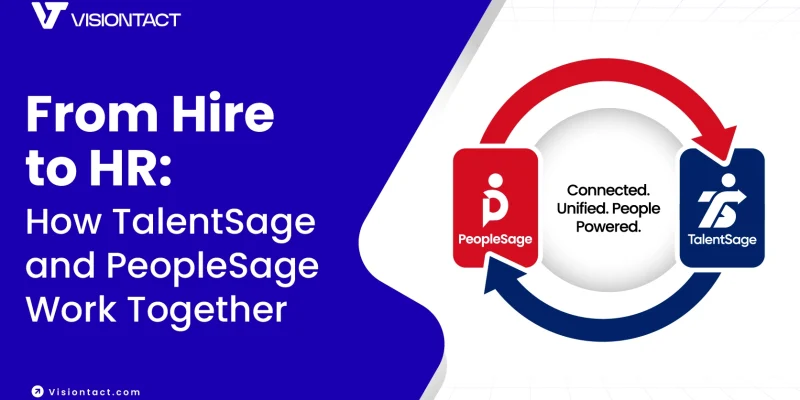
TalentSage and PeopleSage are two VisionTact platforms that work together to connect hiring and HR operations. TalentSage handles recruitment, screening, and the hiring decision. When a candidate is hired, the context built during recruitment can carry forward into PeopleSage, where that person becomes a managed employee record. Together they form an integrated recruitment and HR platform that removes the gap between choosing someone and managing them.

The Gap Between Hiring and HR

Most organisations treat hiring and HR as two separate problems, and they buy two separate tools to solve them. A recruitment system manages the search, the screening, and the offer. An HR system manages the employee once they have started. On paper this division makes sense. In practice it creates a gap, and that gap is where a surprising amount of value gets lost.

Think about what actually happens when someone is hired. Over the course of a recruitment process, a team builds up a detailed picture of a candidate. They know which skills the person was assessed on and how they scored. They have interview feedback from several people. They have notes on strengths, development areas, and what the candidate said they were looking for. They have the context of why this person was chosen over the others. All of that is rich, specific information about a human being who is about to join the company.

Then the candidate accepts the offer, and in most organisations, almost none of that information makes the journey into the HR system. The recruitment file closes. A new employee record opens, blank. Someone re-enters the basic details by hand. The manager who will lead this person starts from scratch, often without ever seeing the interview feedback that explained why the hire was made. The knowledge that took weeks to build evaporates at the exact moment it would be most useful, which is the start of the employment relationship.

This is the gap between hiring and HR. It is not anyone’s fault. It is a structural consequence of running the two functions on disconnected systems. VisionTact built TalentSage and PeopleSage to close that gap, by making the hiring platform and the HR platform work as parts of one connected workflow rather than two separate worlds.

What TalentSage and PeopleSage Each Do

Before looking at how they connect, it helps to be clear on what each platform does on its own. Both are fully standalone products that deliver value independently.

TalentSage: the hiring side

alentSage is VisionTact’s AI hiring platform. It handles the recruitment process from job opening to final hire. It screens and scores candidates against the criteria for a role, structures recruiter workflows so every search follows a consistent process, supports AI assisted evaluation and comparison of shortlisted candidates, and integrates skills assessments into the hiring pipeline. The result is a hiring process that is faster, more consistent, and better documented than manual recruitment. You can read the full detail in What is TalentSage? AI Hiring Platform Explained


PeopleSage: the HR side

PeopleSage is VisionTact’s HR operations platform. It centralises employee management, attendance, leave, payroll, performance tracking, and internal communication into one structured system. It is designed to replace the scattered tools and manual coordination that slow HR teams down, giving operations leaders a single source of truth for everything happening across their people. You can read the full detail in What is PeopleSage? HR Operations Platform Explained.
 
On their own, each platform solves a real problem. Together, they solve a problem that neither can solve alone: the loss of context that happens at the handoff between hiring and HR.

How the Two Platforms Work Together

The connection between TalentSage and PeopleSage is built around a single idea. The moment a candidate becomes an employee should be a continuation, not a reset.

When a hire is confirmed in TalentSage, the structured information built during the recruitment process is designed to carry forward into PeopleSage rather than being discarded. The candidate profile, the skills assessment results, the interview feedback, and the documentation from the offer stage can become the foundation of the employee record from day one.

This changes the experience for everyone involved. The HR team does not start with a blank record that needs manual data entry. The employee record begins already populated with the context that the hiring process produced. The manager who will lead the new employee can see the assessment results and interview feedback that explained the hiring decision, which gives them a head start on understanding the person they are about to manage. And the new employee experiences an onboarding that feels informed, because the company already knows who they are rather than asking them to reintroduce themselves.

For organisations that run both platforms, this turns the handoff from a point where value leaks out into a point where value carries through. As an integrated recruitment and HR platform, TalentSage and PeopleSage are designed to make the full journey, from first application to established employee, one continuous flow of context.

It is worth being clear about the boundaries here. Both platforms remain fully usable on their own. An organisation can run TalentSage for hiring without PeopleSage, or PeopleSage for HR without TalentSage. The connection is an advantage for teams that choose both, not a requirement that locks them in.


Who This Is For

The connected TalentSage and PeopleSage workflow is most valuable for organisations where hiring volume and people management both matter, and where the gap between them is costing time and context.
  • HR leaders who are tired of employee records starting from scratch and want the knowledge from the hiring process to inform how a person is managed from day one.
  • Talent acquisition leaders who put real effort into assessing and understanding candidates and want that work to have value beyond the hiring decision itself.
  • Operations leaders who want one connected view of the people function, from the roles being filled to the workforce being managed, rather than two disconnected systems they have to reconcile.
  • Founders of growing companies who are building their hiring and HR processes at the same time and want to put them on connected infrastructure from the start rather than stitching two tools together later.
  • Hiring managers who want to lead new team members with the benefit of the assessment and interview context, rather than meeting their new report with no background at all.
These are organisations in sectors like healthcare, commercial services, technology, and government, where both hiring and people operations are run at meaningful scale.


How It Works

Bringing TalentSage and PeopleSage together follows a clear path that mirrors the natural lifecycle of an employee.
  • Step one: hire in TalentSage. A role is opened, candidates are screened and assessed, the shortlist is evaluated, and a hiring decision is made and documented inside TalentSage. By the end of this stage, the platform holds a structured record of the chosen candidate and why they were chosen.
  • Step two: carry the context forward. When the hire is confirmed, the candidate’s structured profile, assessment results, and interview documentation can transfer into PeopleSage. This is the step that closes the gap. Instead of the recruitment file closing and a blank HR record opening, the information continues.
  • Step three: onboard with context in PeopleSage. The new employee record in PeopleSage begins already populated. Onboarding workflows, attendance, leave, and the rest of the HR operation pick up from a record that reflects what the company already knows about this person.
  • Step four: manage the full lifecycle. From that point, PeopleSage manages the employee across their time with the company, with the original hiring context available as part of their record rather than lost at the door.

Why It Matters

The value of connecting hiring and HR is easy to underestimate because the cost of keeping them separate is quiet. Nobody sends an alert when context is lost at a handoff. It just quietly disappears, and the organisation absorbs the consequence without ever attributing it to the gap.

When the hiring context carries into HR, onboarding gets better. A new employee whose manager already understands their strengths and development areas has a smoother start than one whose manager is meeting them cold. That early experience shapes how engaged and how quickly productive a new hire becomes.

When the employee record starts populated rather than blank, the HR team saves the manual work of re-entering information that already exists, and avoids the errors that manual re-entry introduces. The data is more accurate because it is carried, not retyped.

When the same context follows a person from candidate to employee, decisions made later in the employment relationship can draw on a fuller history. Performance conversations, development planning, and role changes all benefit from having the original assessment and hiring context available.

And when leadership can see the people function as one connected flow rather than two separate systems, they get a clearer picture of how hiring quality translates into employee performance over time. That connection between who you hire and how they do is one of the most valuable things an organisation can learn, and it is almost impossible to see when hiring and HR live in separate, disconnected tools.

None of this requires overstating the case. The point of connecting TalentSage and PeopleSage is simple: the effort a company puts into hiring someone well should keep paying off after they are hired, not reset to zero on their first day.

How This Fits Into the VisionTact Ecosystem

TalentSage and PeopleSage are two of the five platforms VisionTact has built, each addressing a different part of how a modern enterprise operates. The hiring to HR connection described in this post is one example of a broader principle behind how VisionTact builds: each platform is complete on its own, and each is designed to connect naturally with the others when an organisation is ready.

The same thinking applies across the ecosystem. Customer communication, operational execution, and creative production are handled by other VisionTact platforms, and they connect to each other in the same spirit, standalone where you need them to be and joined up where that adds value.

To understand the full picture and the thinking behind building a connected ecosystem rather than a single monolithic tool, the foundational article on this blog is Houston to Dubai: How VisionTact Builds AI for Global Enterprises.

The connection between hiring and HR is the clearest place to see that philosophy in action, because the journey from candidate to employee is one most organisations experience as broken, and it does not have to be.

Conclusion

The gap between hiring and HR is one of those problems that organisations stop noticing because they assume it is just how things work. You hire someone in one system, you manage them in another, and the knowledge built during recruitment quietly disappears at the handoff. It feels normal because it is common, but common is not the same as necessary.
 
TalentSage and PeopleSage are designed to close that gap. As an integrated recruitment and HR platform, they let the context built during hiring carry forward into the employee record, so the journey from first application to established employee is one continuous flow rather than two disconnected stages. Each platform stands on its own, and together they make the people function work as a connected whole.
 
If your organisation runs hiring and HR on separate systems and you can feel the cost of the gap between them, the most useful next step is to see how the two platforms connect and discuss how that maps to your team.
 
Explore TalentSage at talentsage.io and PeopleSage at peoplesage.com, or talk to VisionTact about connecting them.

Frequently Asked Questions

How do TalentSage and PeopleSage work together?

TalentSage handles recruitment and the hiring decision, and PeopleSage handles HR operations once someone is employed. When a candidate is hired in TalentSage, the structured profile, assessment results, and interview context can carry forward into PeopleSage, where the person becomes a managed employee record. This connects hiring and HR into one continuous workflow.

Do I have to use both TalentSage and PeopleSage together?

No. Both are fully standalone platforms. You can use TalentSage for hiring without PeopleSage, or PeopleSage for HR operations without TalentSage. The connection between them is an advantage for organisations that choose both, not a requirement.

What is an integrated recruitment and HR platform?

It is a setup where the hiring system and the HR system work as one connected workflow rather than two separate tools. Instead of an employee record starting blank after a hire, the context built during recruitment carries forward, so hiring and people management share the same information.

What information carries from TalentSage to PeopleSage when someone is hired?

The candidate’s structured profile, skills assessment results, interview feedback, and offer stage documentation can carry forward, becoming the foundation of the new employee record in PeopleSage rather than being re-entered by hand.

Why does connecting hiring and HR matter?

When hiring context carries into HR, onboarding is more informed, employee records start accurate rather than blank, manual re-entry and its errors are reduced, and leadership can see how hiring quality connects to employee performance over time. Keeping the two separate quietly loses all of that.

Who benefits most from connecting TalentSage and PeopleSage?

HR leaders, talent acquisition leaders, operations leaders, founders of growing companies, and hiring managers in organisations where both hiring volume and people management are significant benefit most from removing the gap between the two functions.

Are TalentSage and PeopleSage built by the same company?

Yes. Both are built by VisionTact, an AI development company with offices in Houston, Texas and Dubai Silicon Oasis, UAE. Because they share a maker, they are designed to connect rather than being two unrelated tools forced together.

Where can I learn more about each platform?

TalentSage is available at talentsage.io and PeopleSage is available at peoplesage.com. VisionTact, the company behind both, can be reached at visiontact.com to discuss connecting them.
Share Blog
You may like
Vision Tact White Logo

Join our community: Sign up for the newsletter and enjoy a curated dose of cool reads every week.

Follow Us

Let's Talk About Your Business Goals

Book your free 30-minute strategy session. No commitment, no hard sell  just real advice tailored to your needs.

Waiting List Form
Please enable JavaScript in your browser to complete this form.
Name