What Are AI Agents? A Practical Guide for Business Leaders

AI agents are software systems that can pursue a goal with a degree of independence: they take an objective, break it into steps, use tools and data to carry those steps out, and adjust when conditions change. That is what separates them from chatbots, which converse but do not act, and from traditional automation, which acts but only along a fixed script. SI Agent for businesses, AI agents for business use cases matter most in work that is too variable for rigid automation but too repetitive to deserve constant human attention.

Why Every Business Leader Is Suddenly Hearing About AI Agents

Every wave of technology produces one term that leaps from engineering conversations into boardrooms before anyone agrees on what it means. Right now that term is AI agents. It is in vendor pitches, analyst reports, and conference keynotes, usually attached to large promises and rarely attached to a clear definition. For a business leader trying to make sensible decisions, this is an unhelpful combination: the pressure to have an answer arrives before the understanding does.

The frustrating part is that the underlying idea is genuinely important and genuinely simple. The shift the term describes is real, and it is the most significant change in what business software can do since cloud computing. But it is buried under jargon, inflated claims, and the tendency of every vendor to relabel whatever they already sold as an agent.

This guide does one job: it explains what AI agents actually are in plain business terms, what they are not, and where they create real value, so that the next time the term appears in a pitch or a strategy meeting, you can evaluate it on substance. No engineering background required, and no claims that outrun what the technology reliably does today.

What Is an AI Agent

An AI agent is a software system that can pursue a goal with a degree of independence.

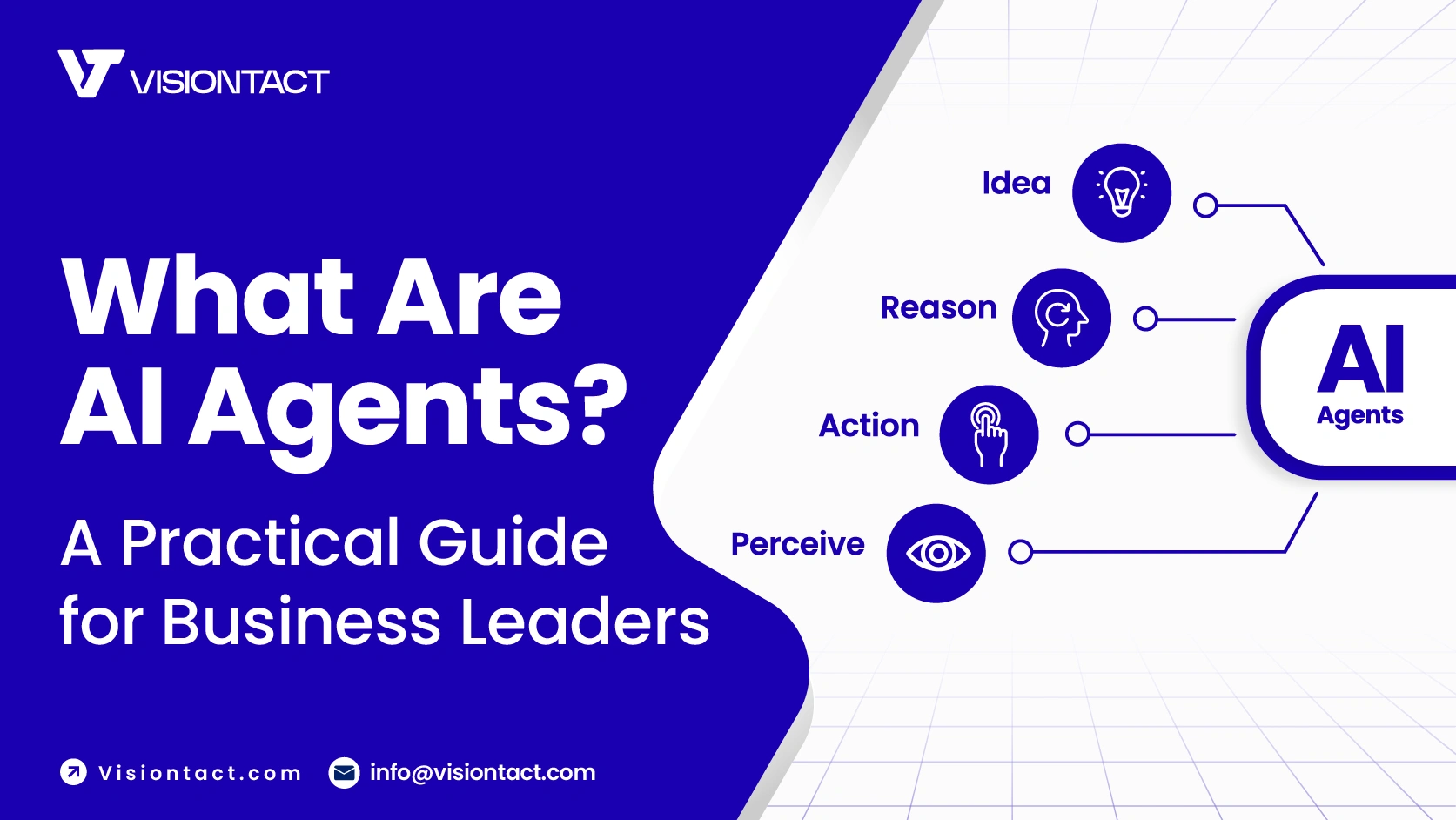
That sentence carries the whole idea, so it is worth unpacking. Traditional software waits for instructions and executes them exactly. An agent is given an objective and works out the steps itself: it perceives its situation through data and inputs, reasons about what to do next, acts by using tools such as searching records, sending messages, updating systems, or calling other software, and then observes the result and adjusts. Perceive, reason, act, adjust. The loop repeats until the goal is reached or the agent determines it needs human input.

A useful comparison is the difference between a calculator and a capable new colleague. A calculator does exactly what you press, instantly and perfectly, and nothing more. A capable colleague can be told “sort out this customer’s billing issue” and will look up the account, check the history, apply the right policy, draft the response, and escalate to you only if something unusual appears. The agent is the second model, implemented in software. You delegate an outcome rather than dictating every step.

Two more terms are worth having. Agentic AI is simply the adjective form: systems built to behave this way. Multi agent systems are setups where several agents with different roles work together on complex reasoning and execution tasks, one gathering information, another checking it, another acting on it, the way a small team divides work. These are the systems VisionTact builds within its generative AI and AI agent development work, and the principle is the same at every scale: goals in, coordinated steps out.

What AI Agents Are Not

Because the term is being stretched over everything, the fastest way to understand agents is to be clear about the neighbouring things they are not.

An agent is not a chatbot

A basic chatbot converses. It answers questions from a knowledge base and hands anything complicated to a human. It talks about work but does not do work. An agent can hold the same conversation and then actually perform the task discussed: look up the order, process the change, update the record. The dividing line is action.

An agent is not traditional automation.

Classic automation follows a fixed script: when X happens, do Y. It is excellent for perfectly predictable work and brittle everywhere else, because the moment reality deviates from the script, the automation stops or errs. An agent handles variation, because it reasons about the situation rather than pattern matching against a script. Automation executes steps. Agents pursue goals.


An agent is not a general intelligence.

An agent is not a digital employee who can do anything, and vendors implying otherwise should be treated with caution. Today’s agents work well inside defined domains with clear goals, good data, and sensible guardrails, and they work badly when asked to operate with none of those. The realistic picture is narrower than the hype and far more useful than skepticism suggests.
A one line test for any vendor pitch: does the system decide steps toward a goal and take actions in other systems, or does it only respond when prompted along paths someone predefined? The first is an agent. The second is a chatbot or a workflow with new branding.


Who This Is For

This guide, and agents generally, matter most to a few groups.
  • Founders and executives: who need a working understanding of agents to evaluate vendor claims, prioritise investment, and answer the board question of what the company is doing about agentic AI with substance rather than a slogan.
  • Operations leaders: who own processes full of variable, repetitive work: handling requests, coordinating steps across systems, chasing statuses, the work too irregular for scripts and too constant for people to enjoy.
  • Customer experience leaders: whose teams handle high volumes of interactions where most cases are routine, some are not, and telling the difference currently requires a human on every single one.
  • IT and digital leaders: who will be asked to integrate agents with existing systems and need to understand what that actually involves before promises get made.
  • Leaders who already invested in chatbots or automation: and found the ceiling: the bot that deflects but cannot resolve, the workflow that breaks on every exception. Agents are specifically the technology for the work those tools could not reach.

Where AI Agents Create Real Business Value

The honest heuristic is this: agents earn their place in work that is too variable for rigid automation but too repetitive to deserve constant human attention. That middle band is enormous, and it is where most operational cost hides. Some grounded examples of what agent systems can support:

  • Customer interaction and resolution: Not just answering questions, but resolving requests end to end: checking the account, applying the policy, making the change, confirming the outcome, and escalating the genuinely unusual cases to people with full context attached.
  • Internal knowledge and operations support: Agents connected to company systems can help teams retrieve answers, prepare summaries, draft documents, and carry out multi step internal requests that today bounce across inboxes.
  • Process coordination: Work that spans several systems, where today a person acts as the glue, copying between tools and chasing statuses, is a natural fit. The agent becomes the glue, and the person supervises outcomes instead of performing the plumbing.
  • Qualification and triage: Incoming leads, requests, applications, and tickets all need the same first treatment: understand it, gather what is missing, decide where it goes. Agents are well suited to this front door work at volume, passing humans a qualified, contextualised case instead of a raw one.

The common thread is delegation with judgment. Anywhere your organisation pays people to be reliable executors of variable routine, an agent is worth evaluating.

A Live Example: An Agent Answering Your Phone

Abstract definitions land better with a running example, and VisionTact operates one in production. VoiceTact, the company’s AI voice agent platform, is an agent in exactly the sense this guide describes, applied to business phone calls.

Consider what happens on an inbound call. The system perceives, understanding what the caller is saying in Arabic or English. It reasons, working out the caller’s intent and what this specific situation needs. It acts, resolving routine matters end to end, qualifying a sales enquiry through structured questions, or routing to the right human with a full summary attached. And it adjusts, following the conversation wherever the caller actually takes it rather than forcing them down a scripted menu. Perceive, reason, act, adjust, the agent loop, running on live customer calls around the clock.

The contrast with the old technology makes the definition concrete. A traditional phone menu is automation: press one for billing, a fixed script, brittle at every deviation. VoiceTact is an agent: give it the goal of handling this caller properly, and it works out the steps. The full detail is in What is VoiceTact? AI Voice Agent Platform Explained.

The broader point for a business leader: agents are not a future technology awaiting maturity. Scoped correctly, they are in production now, doing real operational work.

How It Works

For an organisation moving from curiosity to a working agent, the path follows the same discovery first discipline that governs any serious AI project.

  • Step one: identify the right work. Not every process deserves an agent. The evaluation looks for the middle band described above, high volume, variable, multi step work, and prioritises use cases by value, feasibility, and data readiness. This is strategy work, and skipping it is how agent projects join the general population of failed AI projects.
  • Step two: define the goal, the tools, and the guardrails. An agent needs three things designed deliberately: a clear objective, access to the systems and data it must use to act, and explicit boundaries, what it may decide alone, what requires human approval, and when it must escalate. Guardrails are not a limitation on the value. They are what makes the value safe to capture.
  • Step three: build, integrate, and test against reality. The agent is developed and connected to the real systems it will work in, then tested on real cases, including the messy ones, until its judgment within its domain is dependable. Integration is where much of the genuine engineering lives, which is why agent capability belongs inside a broader custom development discipline rather than as a bolt on.
  • Step four: deploy with supervision, then widen gradually. Agents go live with human oversight, handling a defined slice of work while people review outcomes. As trust is earned case by case, the slice widens. This staged handover is how organisations capture the value without betting the customer experience on day one.

Why It Matters

Strip away the noise and the business significance of agents comes down to a single shift: software is moving from executing instructions to pursuing outcomes.

That shift changes the economics of a large category of work. Until now, organisations had two options for variable routine work: script it with automation, which fails on variation, or staff it with people, which scales linearly with volume. Agents open a third option, delegate it with guardrails, and that option scales without the linear cost while handling the variation scripts cannot.

It also changes what your existing teams do. When agents absorb the middle band of work, people move up the stack, toward the judgment calls, the exceptions, the relationships, the work that actually required a human all along. The organisations that navigate this well will not be the ones that adopted agents fastest, but the ones that redesigned roles around them most thoughtfully.

And it changes vendor conversations right now. Agentic claims are already in every pitch you receive. Leaders who understand the perceive, reason, act, adjust loop, and who ask whether a system truly decides steps and takes actions, will buy substance. Leaders who do not will buy rebranded chatbots.

A measured note belongs here too. Agents are powerful inside well defined domains and unreliable outside them. The winning posture is neither rushing to deploy agents everywhere nor waiting for some finished future version. It is picking one well chosen, well guarded use case, proving value, and expanding from evidence. That is not caution slowing ambition down. It is how ambition compounds.

How This Fits Into the VisionTact Ecosystem

Agent development sits inside VisionTact’s generative AI and AI agents service line, where the company builds AI agent development solutions for automation and knowledge systems, including multi agent systems that perform complex reasoning and execution tasks. The work follows the same discovery first process as every VisionTact engagement, which matters more for agents than for most systems, because an agent is only as good as the goal definition, integrations, and guardrails designed around it.

That process discipline is covered across this series: the overall practice in What is Custom AI Development? A Buyer’s Guide for Enterprises, the vendor evaluation in How to Choose an AI Development Company: 7 Questions Every Buyer Should Ask, and the strategy work that should precede any build in AI Strategy Before AI Development: Why Projects Fail Without a Roadmap.

VisionTact also runs its own agent technology in production through VoiceTact, which means the company’s agent guidance comes from operating the technology daily across the USA and the Gulf, not from theory. The story of how VisionTact builds across both markets is in Houston to Dubai: How VisionTact Builds AI for Global Enterprises.

Conclusion

AI agents are software systems that pursue goals with a degree of independence: they perceive, reason, act, and adjust, which separates them from chatbots that only converse and automation that only follows scripts. For businesses, their value concentrates in the middle band of work that is too variable to script and too repetitive to staff, and that band is where a remarkable share of operational cost lives.

The technology is in production today, answering phones, resolving requests, coordinating processes, and the practical question for leaders is no longer whether agents are real but which piece of your operation deserves one first. That is a strategy question before it is a technology question, and it rewards the same discipline as any AI investment: pick the right work, define the goal and guardrails, prove value, expand from evidence.

If you are weighing where AI agents for business use could fit in your operation, the most useful next step is a conversation about your specific workflows. VisionTact’s free 30 minute strategy session exists for exactly that.

Book your free strategy session at visiontact.com.

Frequently Asked Questions

What are AI agents?

AI agents are software systems that pursue a goal with a degree of independence. Given an objective, an agent works out the steps, uses tools and data to carry them out, observes results, and adjusts. The core loop is perceive, reason, act, adjust, which distinguishes agents from software that only follows fixed instructions.

How are AI agents different from chatbots?

A chatbot converses: it answers questions and hands complex cases to humans. An agent can hold the same conversation and then actually perform the task, such as looking up an account, applying a policy, or updating a system. The dividing line is action. Chatbots talk about work, agents do work.

How are AI agents different from traditional automation?

Traditional automation follows a fixed script and breaks when reality deviates from it. An agent reasons about each situation and handles variation, pursuing the goal by different steps when conditions change. Automation executes predefined steps, while agents pursue outcomes.

What is agentic AI?

Agentic AI describes systems built to behave as agents: taking goals, planning steps, acting through tools, and adjusting to results. Multi agent systems extend this by having several specialised agents work together on complex reasoning and execution tasks, the way a small team divides work.

Where do AI agents create the most business value?

Agents create the most value in work that is too variable for rigid automation but too repetitive for constant human attention: resolving customer requests end to end, coordinating processes across systems, triaging and qualifying incoming leads or tickets, and supporting internal knowledge and operations tasks.

Are AI agents being used in real businesses today?

Yes. Scoped to defined domains with clear goals and guardrails, agents are in production now. VoiceTact, VisionTact’s AI voice agent platform, is one example, handling live business calls in Arabic and English, resolving routine matters end to end and escalating complex cases to humans with full context.

What do AI agents need to work safely?

Three things designed deliberately: a clear objective, integration with the systems and data the agent must use to act, and explicit guardrails defining what it may decide alone, what requires human approval, and when it must escalate. Agents deployed without these fail or cause harm, which is why agent projects should follow a strategy first process.

How should a business start with AI agents?

Start with one well chosen use case rather than a broad rollout: identify high volume, variable, multi step work, define the goal and guardrails, integrate with real systems, deploy with human supervision, and widen the agent’s scope as it earns trust. VisionTact offers a free 30 minute strategy session to help identify where an agent would create measurable value first.
Share Blog
You may like
Vision Tact White Logo

Join our community: Sign up for the newsletter and enjoy a curated dose of cool reads every week.

Follow Us

Let's Talk About Your Business Goals

Book your free 30-minute strategy session. No commitment, no hard sell  just real advice tailored to your needs.

Waiting List Form
Please enable JavaScript in your browser to complete this form.
Name