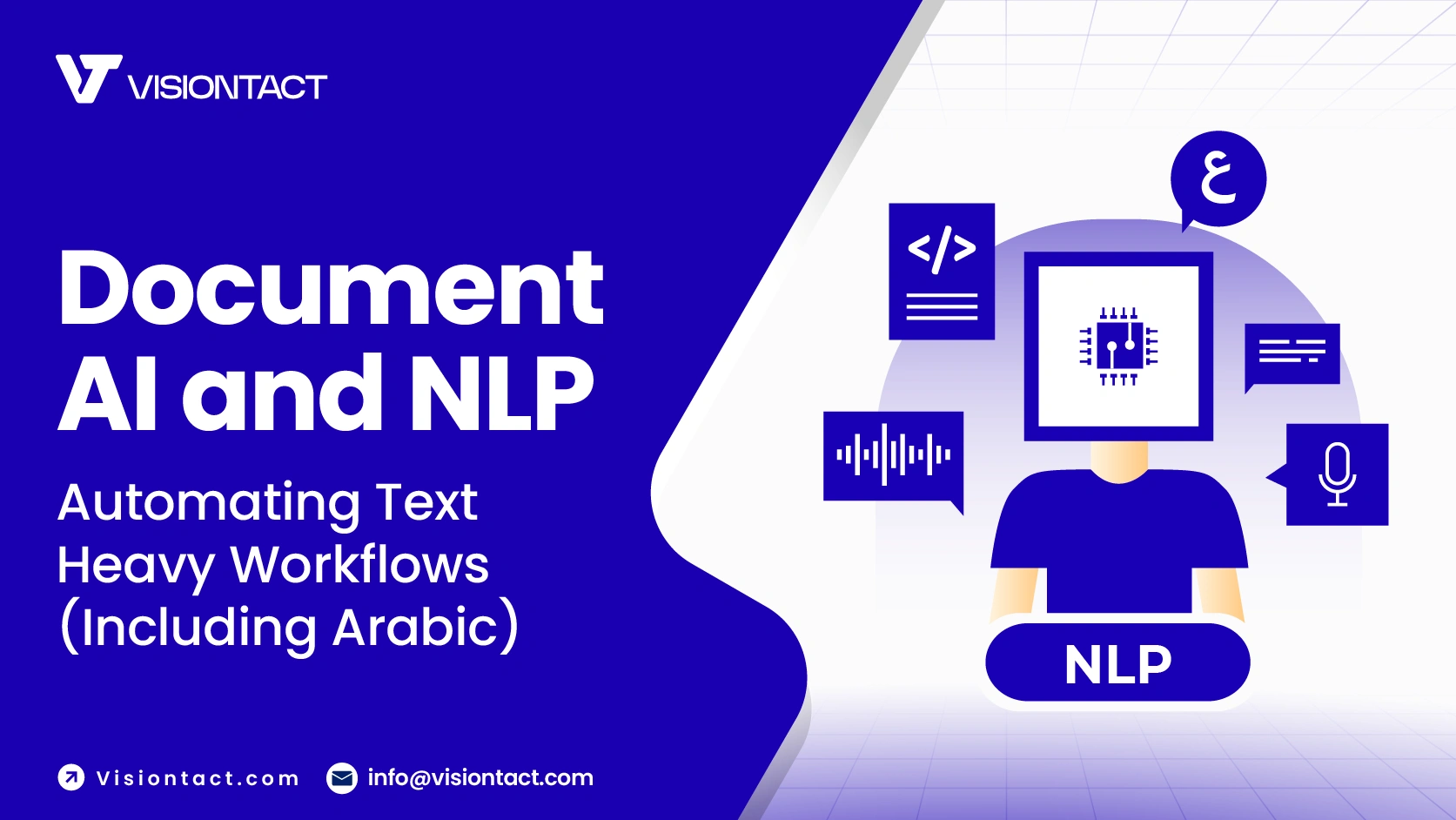

Document AI and NLP processing English and Arabic business documents automatically, extracting data from invoices, contracts, and forms

Document AI and NLP: Automating Text-Heavy Workflows, Including Arabic

In This Article

  • Quick Answer
  • The hidden cost of text-heavy work
  • What is document AI
  • What natural language processing adds
  • What document AI can do
  • The Arabic advantage for Gulf enterprises
  • Who this is for
  • How it works
  • Why it matters
  • How this fits into the VisionTact ecosystem
  • Conclusion
  • Frequently asked questions
Document AI, also known as intelligent document processing, is the use of artificial intelligence and natural language processing to read, understand, and process documents the way a person would, but at far greater scale and speed. It extracts data from invoices, contracts, forms, and reports, classifies documents, and routes the information into business systems without manual entry. Modern document AI can support both Arabic and English, which makes it directly useful for enterprises operating across the United States and the Gulf.

The Hidden Cost of Text-Heavy Work

Every organisation runs on documents, and most underestimate how much they cost. Invoices arrive and someone keys the numbers into an accounting system. Contracts get signed and someone reads them to pull out dates, obligations, and renewal terms. Forms come in and someone transfers the answers into a database. Reports pile up and someone reads through them to find the three facts that matter. None of this work is especially complex, but it is repetitive and time-consuming, and it consumes an enormous amount of skilled human time on tasks that use almost none of that skill.

The cost is easy to miss because it is spread thin. No single document takes long. But across a finance team processing thousands of invoices a month, a legal team reviewing hundreds of contracts, or an operations team handling a constant stream of forms, the hours add up to full-time roles spent on manual transcription and reading. Worse, the work is error-prone in a way that compounds quietly. A mistyped figure, a missed clause, a form entered into the wrong field: each is small, and each can become expensive later.

There is also a ceiling problem. Manual document work does not scale gracefully. When volume doubles, the only options are to hire more people or accept a growing backlog, and both are poor answers. This is the problem document AI exists to solve, by enabling software to read documents and enter data automatically, taking on the reading and keying that currently consumes so much human attention.

What Is Document AI

Document AI is the application of artificial intelligence to reading, understanding, and processing documents automatically. It is also widely known as intelligent document processing, or IDP, and the two terms describe the same field.

At its simplest, the technology takes a document a human would normally have to read and act on, such as an invoice, a contract, a form, or a report, and it extracts the meaningful information, understands what that information represents, and passes it into the systems where it needs to go. It handles a range of formats, including typed documents, scanned images, PDFs, and structured forms.

What separates document AI from older approaches is its ability to understand documents rather than simply capture text. Basic OCR (Optical Character Recognition), the technology that has existed for years, can turn a scanned page into machine-readable text. But it does not know that a particular number is the invoice total rather than a line item, or that a particular date is a contract renewal rather than a signing date. Intelligent document processing adds that layer of comprehension. It recognises not just the words but their meaning and role, which is what allows it to replace human reading rather than simply digitising a page.

That comprehension comes from natural language processing, which is the part of AI that deals with human language, and it is worth understanding on its own.

What Natural Language Processing Adds

Natural language processing, usually shortened to NLP, is the branch of artificial intelligence focused on understanding and working with human language as people actually use it.

Human language is messy. The same thing can be said many ways, meaning depends on context, and important information is often implied rather than stated plainly. NLP is what lets software cope with that messiness. In a document context, it is what allows the system to understand that “net 30,” “payable within thirty days,” and “due one month from invoice date” all mean the same thing, or to pull the governing law clause out of a contract even when different contracts phrase and place it differently.

NLP is what turns AI document processing from rigid template matching into genuine understanding. A template-based system breaks the moment a document does not match the expected layout. An NLP-based system reads the document for meaning, which means it can handle the variation that real-world paperwork always contains: different vendors’ invoice formats, different lawyers’ contract styles, different branches’ ways of filling in the same form.

For enterprises, this is the difference between a document automation project that works only in a demo and one that survives contact with the actual variety of documents a business receives.

What Document AI Can Do

Intelligent document processing covers a range of capabilities that together automate most of what people currently do manually with text. These are the main ones, all of which sit within VisionTact’s document AI and NLP work.

Data Extraction

Pulling specific information out of documents automatically: totals and line items from invoices, key terms and dates from contracts, answers from forms, figures from reports. The extracted data flows into business systems without anyone keying it in.

Document Classification

Automatically sorting incoming documents by type and routing them to the right process or team. A mixed stream of invoices, applications, and correspondence gets separated and directed without a person triaging each one.

Information Understanding and Summarisation

Reading long documents and identifying or summarising the parts that matter, so a person reviewing a hundred-page report or a dense contract starts from the key points rather than reading every line.

Text Classification and Sentiment Analysis

Analysing large volumes of text, such as customer feedback, support messages, or survey responses, to categorise them and detect tone and sentiment at a scale no human team could match.

Search and Retrieval Across Documents

Making large document collections searchable by meaning rather than just keywords, so people can find the right clause, record, or answer across thousands of files quickly.

Multilingual Processing

Handling documents in more than one language within the same workflow, which for enterprises in the Gulf specifically means processing bilingual Arabic and English documents together, a capability covered in its own section next.

The Arabic Advantage for Gulf Enterprises

For enterprises operating in the UAE, Saudi Arabia, and the wider Gulf, one capability matters more than any other: the ability to process Arabic documents as reliably as English ones. This is genuinely harder than it sounds, and it is where many document automation tools quietly fall short. Arabic presents several challenges that English does not.
 
It is written right to left, which breaks the layout assumptions many systems are built around. It is a morphologically rich language, meaning a single root word can take many forms through prefixes, suffixes, and internal changes, so the same concept appears in numerous shapes that a system has to recognise as related. Its letters change shape depending on their position within a word, and the diacritical marks that affect meaning are frequently omitted in everyday business writing. On top of the language itself, real commercial documents are rarely tidy: mixed Arabic-English business documents are common, where a single contract or invoice carries both languages, and bilingual government forms across the Gulf routinely present the same fields in Arabic and English side by side
 
A system built for English and then loosely adapted tends to handle all of this poorly, which means Gulf enterprises get automation for half their paperwork and manual work for the rest. Document processing designed for dual-language operation from the start removes that gap. It lets a business in Dubai or Riyadh automate the full stream of documents it actually receives, across both languages, rather than only the English portion. For organisations whose contracts, invoices, government paperwork, and correspondence routinely arrive in Arabic, this is not a minor feature. It is the difference between document automation that fits the market and automation that only fits half of it.
 
This is why multilingual capability, and Arabic specifically, sits at the centre of how VisionTact approaches document AI for the Gulf. The company builds for the reality that enterprises in its markets work in both languages every day, so the technology has to as well.

Who This Is For

Document AI delivers the most value in roles and functions where text-heavy work is a daily reality.
 
  • Finance and accounts teams processing high volumes of invoices, receipts, purchase orders, and statements, where automated data extraction removes hours of manual entry and reduces costly keying errors.
  • Legal and contracts teams reviewing agreements to find dates, obligations, clauses, and renewal terms, where document automation can support faster review and reduce the risk of missed details.
  • Operations teams handling constant streams of forms, applications, and paperwork that need to be read, sorted, and entered into systems.
  • Compliance and risk functions that must review large document volumes for specific terms or red flags, where automated analysis can support more consistent and thorough coverage.
  • Customer-facing teams dealing with large volumes of written feedback, messages, or applications, where text classification and sentiment analysis surface patterns no manual review could.
  • Gulf enterprises specifically, where the ability to process bilingual documents in one workflow determines whether automation covers the whole operation or only part of it.

How It Works

A document AI project follows the same discovery-first discipline that governs any serious AI build, moving through four stages.
 
  • Step one: understand the documents and the workflow. The work starts by examining the actual documents an organisation processes, their formats, languages, and variety, and the workflow they feed. This is where the real-world messiness gets mapped, so the system is built for the documents that actually arrive rather than an idealised sample.
  • Step two: design extraction and understanding logic. The system is designed to recognise, extract, and understand the specific information the business needs from each document type, with the NLP tuned to the language and terminology of the industry and, where relevant, configured for multilingual workflows across Arabic and English.
  • Step three: build, train, and test against real documents. The system is developed and tested on real examples, including the awkward ones: unusual formats, mixed-language business documents, poor scans, so its accuracy holds up in production rather than only in a clean demo. Enterprise builds are developed to security standards appropriate for sensitive documents, with encryption and access controls designed in.
  • Step four: integrate, deploy, and improve. The system connects to the business systems where the extracted information needs to go, whether an accounting platform, an ERP, or an operational workflow tool, and goes live with monitoring so accuracy is maintained and improved over time as new document types appear.

How It Works

The case for document AI comes down to what happens to skilled human time and to accuracy when reading and data entry stop being manual.
 
When extraction is automated, the hours people spend transcribing documents come back. That time moves to work that actually needs human judgment: analysis, exceptions, relationships, decisions. The finance analyst stops keying invoices and starts analysing spend. The legal reviewer stops hunting for dates and starts advising on the terms those dates govern.
 
When understanding is automated, accuracy improves. A well-built system does not get tired, distracted, or careless at the end of a long day, which is when manual transcription errors cluster. Consistency across thousands of documents is exactly what machines do well and humans, understandably, do not. When processing scales without linear staffing, the ceiling problem disappears. Volume can double without doubling headcount or accumulating a backlog, which changes what an operation can take on.
 
And for Gulf enterprises specifically, when both languages are handled reliably, automation finally covers the whole document stream rather than leaving the Arabic half as permanent manual work. That completeness is what turns document AI from a partial efficiency into a genuine operational change for businesses in the region.
 
None of this requires overstating what the technology does. Document AI does not eliminate the need for human oversight, and complex or high-stakes documents still deserve human review. What it does is remove the vast volume of routine reading and entry that never needed a human in the first place, which is most of it.

How This Fits Into the VisionTact Ecosystem

Document AI and NLP are part of VisionTact’s custom AI development work, applied to the text-heavy workflows that consume so much time across finance, legal, operations, and compliance functions. The company builds these systems with multilingual capability across Arabic and English at the centre, because enterprises across its markets in the United States and the Gulf work in both languages every day.

AI document processing rarely operates in isolation. The information a system extracts usually needs to trigger something: a payment, an approval, a task, a record update. That is where it connects to operational execution. VisionTact’s operations platform, OpsStak, turns extracted information and the workflows it feeds into structured, tracked tasks with clear ownership, so a processed document does not just become data but becomes action that gets completed and recorded. You can read about that platform in What is OpsStak? AI Operations Platform Explained. 

For the broader picture of how VisionTact approaches custom AI, this post sits within a wider series: the practice overview in What is Custom AI Development? A Buyer’s Guide for Enterprises. 
The strategy discipline that should precede any build in AI Strategy Before AI Development: Why Projects Fail Without a Roadmap. And the company’s two-market foundation in Houston to Dubai: How VisionTact Builds AI for Global Enterprises.

Conclusion

Document AI takes the endless, low-skill, high-volume work of reading and entering documents and hands it to software that can do it faster, more consistently, and at a scale no human team can match. Built on natural language processing, it understands documents rather than merely digitising them, which is what lets it handle the real variety of formats and phrasings that business paperwork always contains.
 
For enterprises in the Gulf, reliable processing of both Arabic and English is the capability that decides whether document automation covers the whole operation or only half of it, and it is where genuinely capable systems separate themselves from tools adapted from English alone.
 
If your teams are spending real time reading and transcribing documents, the fastest way to find where automation would pay off is to look at your actual workflows and the volumes behind them. In a free 30-minute strategy session, VisionTact can help you identify which document processes are the strongest candidates for automation and where the measurable return is likely to be greatest.
 

Frequently Asked Questions

What is document AI?

Document AI, also called intelligent document processing, uses AI and natural language processing to read, understand, and process documents automatically. It extracts data, classifies documents, and passes information into business systems without manual entry.

What is the difference between document AI and OCR?

OCR (Optical Character Recognition) converts a scanned page into text but does not understand what that text means. Document AI adds comprehension, knowing which figure is the invoice total or which date is a renewal, so it can replace human reading rather than just digitising a page.

What is intelligent document processing?

Intelligent document processing, or IDP, is another name for document AI. It combines AI and NLP to extract, classify, and understand information from documents, automating workflows that would otherwise require manual reading and data entry.

Can document AI process Arabic documents?

Yes. It can be built to process Arabic and English together in one workflow. Arabic is harder to handle because of its right-to-left script, rich morphology, and omitted diacritics, so genuine Arabic capability separates purpose-built systems from tools adapted only for English.

What can document AI be used for?

Common uses include extracting data from invoices and forms, reviewing contracts for key terms, classifying and routing documents, summarising long reports, analysing feedback for sentiment, and making large document collections searchable by meaning.

Does document AI replace human review?

No. It removes the routine reading and data entry that never needed human judgment, while complex or high-stakes documents still get human oversight. The aim is to shift skilled time from transcription to analysis and decisions.

How accurate is document AI?

Well-built systems are highly accurate on the document types they are trained for, and their accuracy does not drop with fatigue or volume. Results depend on training the system against the real, varied documents a business actually receives.

Does VisionTact build document AI solutions?

Yes. Document AI and NLP are part of VisionTact’s custom AI development work, built with Arabic and English capability for enterprises across the USA, UAE, and Saudi Arabia. VisionTact offers a free 30-minute strategy session for organisations exploring document automation.
Share Blog
You may like
Vision Tact White Logo

Join our community: Sign up for the newsletter and enjoy a curated dose of cool reads every week.

Follow Us

Let's Talk About Your Business Goals

Book your free 30-minute strategy session. No commitment, no hard sell  just real advice tailored to your needs.

Waiting List Form
Please enable JavaScript in your browser to complete this form.
Name